Our Verdict
A good idea, well executed. Instant personal stories at exactly the level you want is a real advantage over fixed libraries, the voices are convincing, and the free tier is generous enough to judge it before paying. The curated web library is reviewed by named language reviewers. The personalised stories, which are the reason to pay, aren't read by anyone before you read them.
Pros
- ✓Generates personal stories at exactly the level you ask for, in seconds
- ✓Synthetic voices are genuinely convincing
- ✓Tap any word to translate, click to save it to a vocabulary vault with audio
- ✓Sentence building uses lines you have just read and spoken, not unrelated filler
- ✓Comprehension checks show you the story evidence behind each answer
- ✓Very well polished, with powerful personalisation and progress tracking
- ✓The entire web library is free to browse, no signup and no card
Cons
- ✗Your personalised stories, the main paid feature, aren't human-reviewed before you read them
- ✗Automated pronunciation scoring is encouraging rather than genuinely useful
- ✗Generated scenarios drifted towards the fantastical during testing, since retuned towards everyday situations
- ✗No published feature comparison, so the free and premium line is fuzzy
- ✗No native iOS app yet, though one's coming
- ✗No live tutors or open-ended conversation practice
- ✗Library depth drops off outside Spanish, French, German and Italian
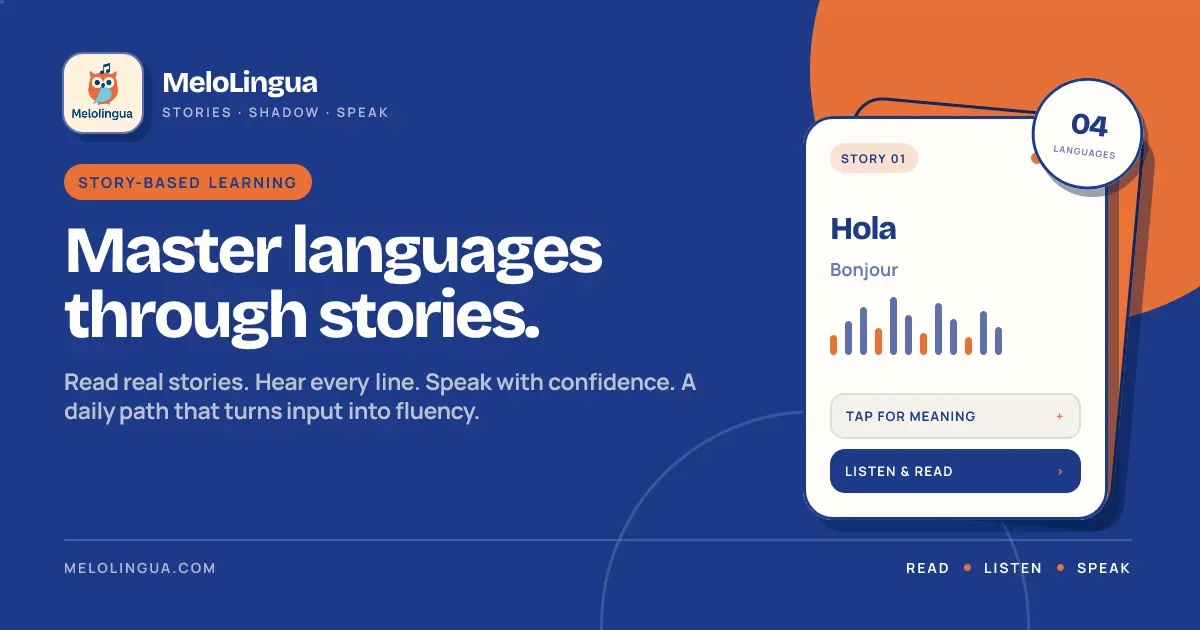
MeloLingua is a story-based language learning app. You read short graded stories, listen to them narrated, practise saying lines out loud, rebuild sentences from the text, and finish with comprehension questions.
What makes it different from the other story apps is that you're not stuck with the stories they wrote. Type in a few words about something from your own life and it'll generate a story from that, at whatever level you ask for.
Is that as good as it sounds? Let's find out.
I was given premium access to test this. There's no affiliate link in this review and no discount code. I get nothing if you sign up, and you can check most of what follows yourself at melolingua.com without handing over a card.
What you actually get
Twelve languages in the app: Spanish, French, German, Italian, Portuguese, English, Dutch, Polish, Russian, Japanese, Korean and Turkish.
The free web libraries are deepest for Spanish, French, German and Italian. The Spanish hub has 25 stories graded across A1 to B2, free to read without an account.
It's a well polished app. That sounds like faint praise but it isn't. A lot of tools in this space are clearly a side project with a payment page bolted on, and this one isn't.
How the loop actually works
This is the bit worth walking through, because it's what separates MeloLingua from apps where you read a story and that's the lesson over.
The full loop runs Read and Listen, then Speak, then Build, then Challenge. I tested it with a Spanish story set in a cafe.
Read and Listen
You get the story text with synchronised narration. Tap any word for a translation on the spot.
Click it and the word saves to a vocabulary vault, which sits in a panel alongside the story so you can review what you've collected and hear each word pronounced.
You can replay the whole story at different speeds, which is more useful than it sounds once you're trying to follow at native pace.
You have to work through every line before the next stage unlocks. Small thing, but it stops you skipping straight to the quiz.
Speak
You hear the model line first, then tap the microphone and say it back. The app scores your attempt and gives you feedback word by word, so you can retry a line or move on.
A bit of healthy scepticism here, and it isn't really about MeloLingua. I read back a line and got 98 percent, "excellent, perfect pronunciation". I doubt my pronunciation was perfect.
But I'd say that about automated pronunciation scoring anywhere, not just here. For real feedback on how you sound, you still need a human ear.
It then gave me 100 percent on the next episode, which didn't help its case.
None of which makes the feature useless. It does give you corrective advice when you're clearly off, and more importantly it gets you saying things out loud, which is the hard part for most learners.
Just treat the number as encouragement rather than an assessment of your accent.
Build
You're shown what a line from the story means in English, then you tap or drag word tiles into a tray to rebuild it in the target language.
You can rearrange the tiles until the sentence sounds right, and there's a Hear it button, a Reset, and a Show me if you're stuck. Three phrases per episode in my case.
If you've used Duolingo you already know this exercise. It's the same tile-building mechanic.
That's not a criticism, it works, and doing it with sentences you've just read and said out loud beats doing it with an unrelated sentence about a bear drinking beer.
One oddity worth flagging, though it's since been dealt with. Build didn't appear at all on the first story I ran, and only showed up on the second episode, after the speaking stage.
MeloLingua tell me that was deliberate, an attempt to make the opening session lighter and get you to Speak and Challenge faster. They've now restored Build to the first story and added fallback coverage for stories without pre-generated Build exercises.
I haven't retested that yet, so if you start today, expect the full loop from story one.
Challenge
A short multiple choice comprehension check on the story you just read. What did the traveller need: a map, a table, a ticket.
The good bit is what happens after you answer. It shows you the story evidence, the actual line that makes the answer correct, so a wrong guess sends you back into the text rather than just marking you down. Anything you miss can be retried.
Stories are serialised into episodes, so finishing one queues up the next, and there's a streak counter to keep you coming back.
Personal stories are the real selling point
The generation is fast and the levelling holds up. The story I ran was a genuine challenge at beginner level, which is what you want.
Being able to ask for a story at a given level and get something usable in seconds solves the oldest problem with graded readers, which is that you run out of them.
The logic behind it is sound, too. If the scene already exists in your head before the words do, the vocabulary has something to attach to. That's a real effect, and a much better reason to generate content than novelty.
The stories themselves are fine. My one reservation is that they could drift towards the fantastical.
Mine involved a small silver key hidden under a cafe table, which reads more like the opening of a mystery novel than anything I'm likely to need to say this week. I'd take more mundane, realistic scenarios over that.
Although there's a counter-argument, and I'm not sure I can dismiss it. A slightly strange story is a more memorable story, and memorable is exactly what you're after when you're trying to make vocabulary stick.
Make the scenario too ordinary and it may just slide off.
That reservation has had an effect. MeloLingua have since retuned the generator to stay closer to the prompt you give it and to favour ordinary daily life: transport, work, school, errands, restaurants, appointments, travel logistics and everyday social situations, rather than adding fantasy or cinematic twists unless you ask for that genre.
I've yet to put that to the test. If it does flatten the odd memorable detail on the way, I'd still take that trade for scenarios I can actually use this week.
The personalisation and progress tracking sitting on top of this is powerful. It knows what you've seen and builds around it.
The AI question
This app leans heavily on AI. The stories are generated and the narration is synthetic, and you should go in knowing that.
On the voices, they're good. I tested several and they held up well. Synthetic narration has quietly got very good in the last couple of years and this is a fair example of it. I wouldn't have flagged them as a problem if I hadn't known.
The curated stories published on the website are reviewed before publication by named language reviewers, for natural language, CEFR level, translations, vocabulary guidance and comprehension questions. Francisco reviews the Spanish readers, and his brief is published, which is more transparency than most apps in this category offer.
The personalised stories are the exception, and they're also the reason to pay. Those are generated on demand, which means no human has read yours before you do.
With a course like Babbel, effectively all of the official content is written and recorded by people, and that verification is part of what you're buying. On the half of MeloLingua you're paying for, it isn't.
In practice this matters less than it once did, because the generation has got good enough that outright errors are rare, and I didn't hit one.
But rare isn't the same as checked, and you're the first reader of every story it writes for you. Worth knowing if you're a beginner and not yet able to spot when something is slightly off.
Pricing
Premium runs at $11.90 a month or $69 a year, so buying a year up front is a big discount. That's standard pricing for this category and it isn't the interesting part.
The interesting part is how much you can do without paying. Every graded story on melolingua.com is free to browse, with no signup and no card, including vocabulary and translations. That's the whole library, not a teaser.
What premium adds is the personalised daily stories, the structured learning path, the guided speaking practice and the progress tracking.
So the free tier gives you the reading and listening, and paying is what turns it into the full loop with content built around you.
Worth saying that their own site is vague about exactly where the line sits, and doesn't publish a proper feature comparison or any usage limits. Not a dealbreaker, since you can try the reading side without handing over anything, but I'd rather see it spelled out.
Platforms
The Android app is live on Google Play. There's no native iOS app yet, though one is on the way and there's a waitlist.
In the meantime iPhone users get the web app in Safari, which works fine.
If you specifically want a native iPhone app in your pocket today, wait for it before committing to an annual plan.
Either way the web hubs are the easiest place to judge the content quality first, whether you're learning Spanish or German.
Who this is for
- Learners who already know that stories and comprehensible input work for them, and who want more graded material than any human-written library can supply.
- Anyone at A1 to B2 in one of the well-covered languages, particularly Spanish, French, German or Italian.
- People who want reading and listening to lead somewhere, rather than being the whole session.
- Android users, and anyone happy working in a browser.
Who this is not for
- Anyone who objects to AI-generated content on principle. That's the entire engine here, and no amount of polish changes it.
- Learners who specifically want every piece of content human-verified, including the stories generated for them, and who'll pay more for that assurance. Babbel is the more obvious fit.
- Anyone who wants trustworthy feedback on their accent. That isn't a MeloLingua failing, it's the state of automated pronunciation scoring generally, and a tutor is still the answer.
- iPhone users who want a native app today.
- Anyone looking for open-ended conversation practice or a live tutor. There's guided speaking and pronunciation practice built on lines from each story, but nothing unscripted, and it doesn't claim to be that.
- Learners past B2, or working in one of the languages where the library is thin.
Verdict
A good idea, well executed. Generating personal stories at exactly the level you want is a real advantage over the fixed libraries its competitors offer, the voices are convincing, the app is polished, and the free tier lets you check all of that yourself before paying.
Learning through stories works, and this is a genuinely fun way to do it.
If you're comfortable with the stories generated for you being AI-written rather than individually human-reviewed, it's a very good option at the price.
Frequently Asked Questions
MeloLingua
Best for: Learners at A1 to B2 who know stories work for them and want unlimited graded material at their exact level
Visit MeloLingua