Our Verdict
A serious tool doing a great job of correcting your output against a curriculum a person actually wrote, for intermediate language learners in Spanish, French, or Hebrew. The annual plan works out at $13 a month, which is more than most language apps charge.
Pros
- ✓Corrections are accurate on errors of form, and it invented nothing across six deliberate traps
- ✓Every correction is tagged with the human-written curriculum topic it comes from
- ✓Separate placement for each skill, then revises your level based on what you actually produced
- ✓Tasks name the structures they want, so it is practice rather than chat
- ✓Real writing practice, which most speaking tools do not offer at all
Cons
- ✗Misses errors of judgement, including a wrong tense inside a topic it had just taught me
- ✗Sometimes fixes something without telling you what was wrong
- ✗To get the most out of it, you'll be paying $13 a month, which is definitely not cheap for a language app
- ✗Not in the App Store or Google Play. It installs to your home screen from the browser instead
- ✗Only three languages, and Spanish and French start at B1, so beginners will bounce off it
Dioma is a language app for intermediate and advanced learners, built around speaking and writing practice with corrections. It covers Spanish, French and Hebrew.
Every day you get three tasks inside a twenty minute frame. You write something, you say something, and about fifteen seconds later a correction comes back.
The selling point is that it corrects what you produce against a curriculum real teachers wrote.
Does that hold up? Let's find out.
Dioma paid for me to thoroughly review what they offer.
The assessment is my own, and a positive verdict wasn't part of the arrangement. There's a 21 day free trial with no card at dioma.com, so you can check most of what follows yourself.
What's changed since I tested it
Dioma shipped a round of updates in October 2026. I haven't retested them yet, so for now this is Dioma's description rather than my own findings.
- It now installs to your phone's home screen from Safari or Chrome, and opens full screen like an app.
- Speaking tasks pick the microphone back up after a screen lock or a call, and keep what you'd already said.
- You can redo an exercise after reading your corrections. The new attempt is the one that counts.
- Coming back to a topic gives you a new exercise instead of the same one again.
On the roadmap, according to Dioma: choosing your own level, a weekly practice goal, and open practice on whatever you like, aimed at early November.
What you actually get
Three languages. Spanish runs B1 to C1, French runs B1 to B2, and Hebrew runs A2 to B2.
Hebrew is the one worth pointing out.
It is the deepest of the three at 308 topics, and there isn't much else out there at that level.
The founder was learning Hebrew at B2 when he built this, which explains why the least commercial language ended up with the most attention.
There's no app in the App Store or Google Play. It runs in a browser, and since October 2026 you can add it to your phone's home screen.
The setup is better than most
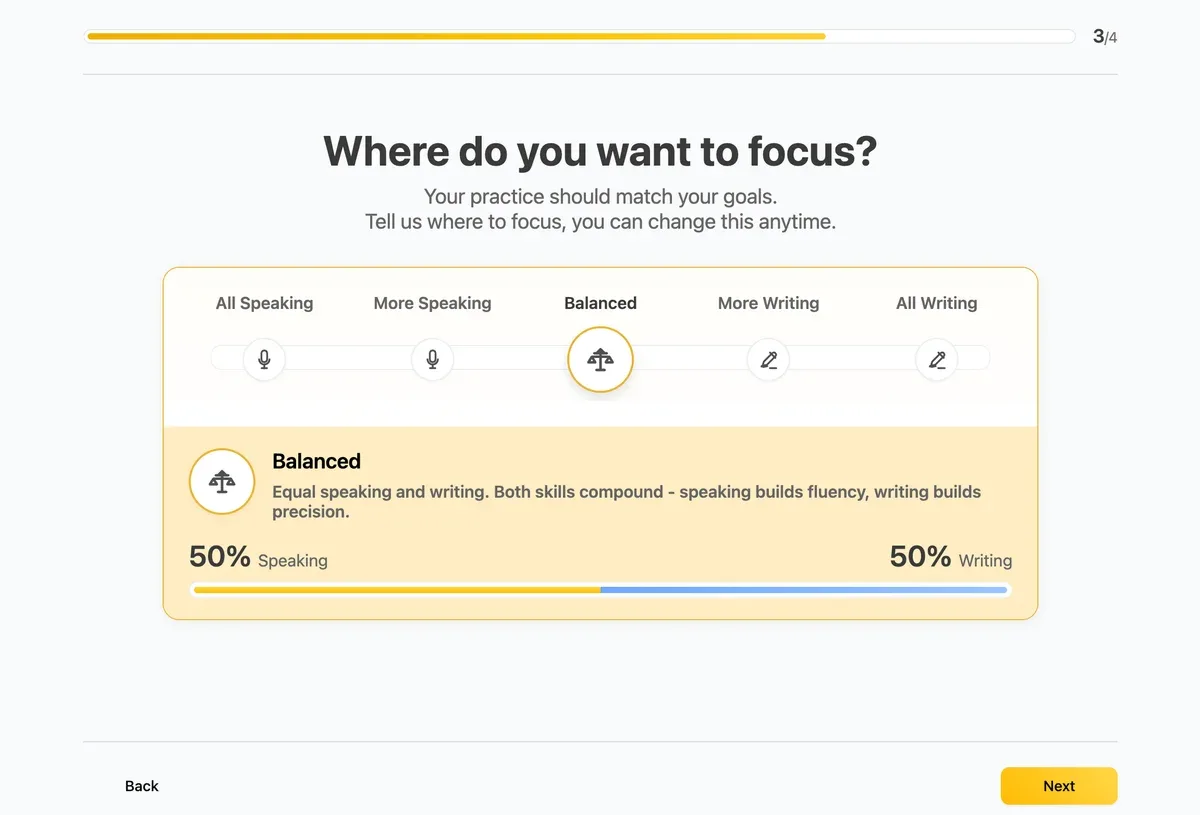
You place yourself separately in each of the four skills: reading, listening, speaking and writing.
That matters more than you'd think, because hardly anyone is level across all four. Understanding at B2 while speaking at A2 is the standard intermediate shape, and one overall number hides exactly the gap that brought you here.
Most tools just ask you to pick a level and get on with it.
After that you set a focus, anywhere from all speaking to all writing, and pick what you're learning for. General life, health, relationships, culture and so on.
It's still self assessment, and we're all famously bad at rating ourselves. There's no placement test yet, though one is planned. I'll come back to why that turned out not to matter.
What a session looks like
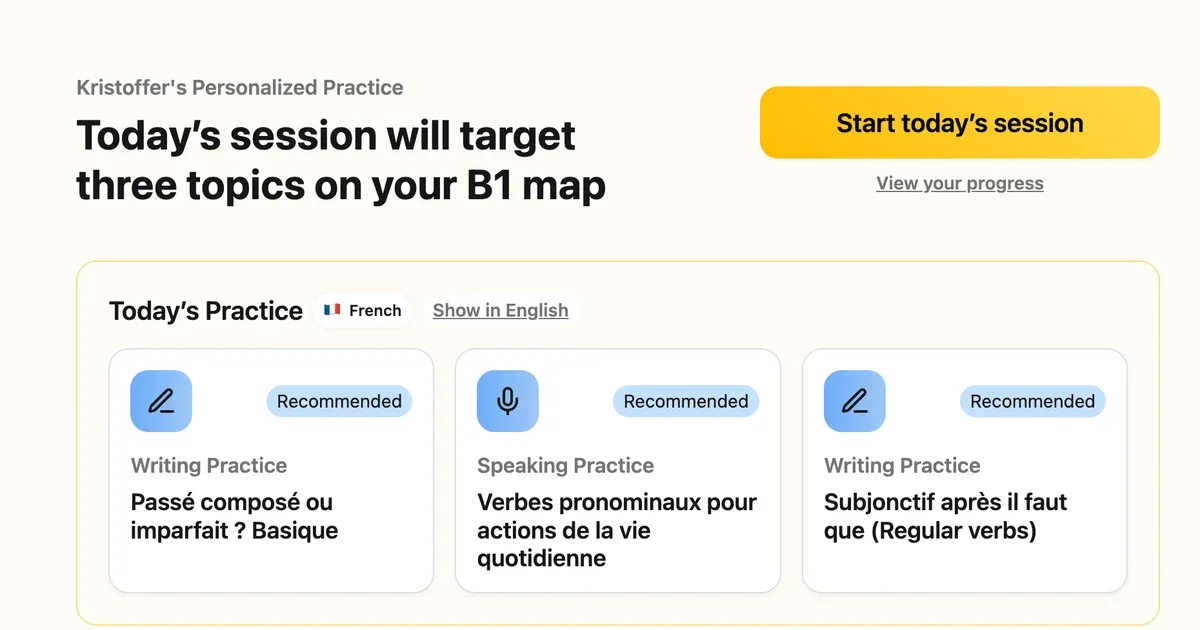
Three tasks, and before you start the daily page tells you which curriculum topics they're targeting.
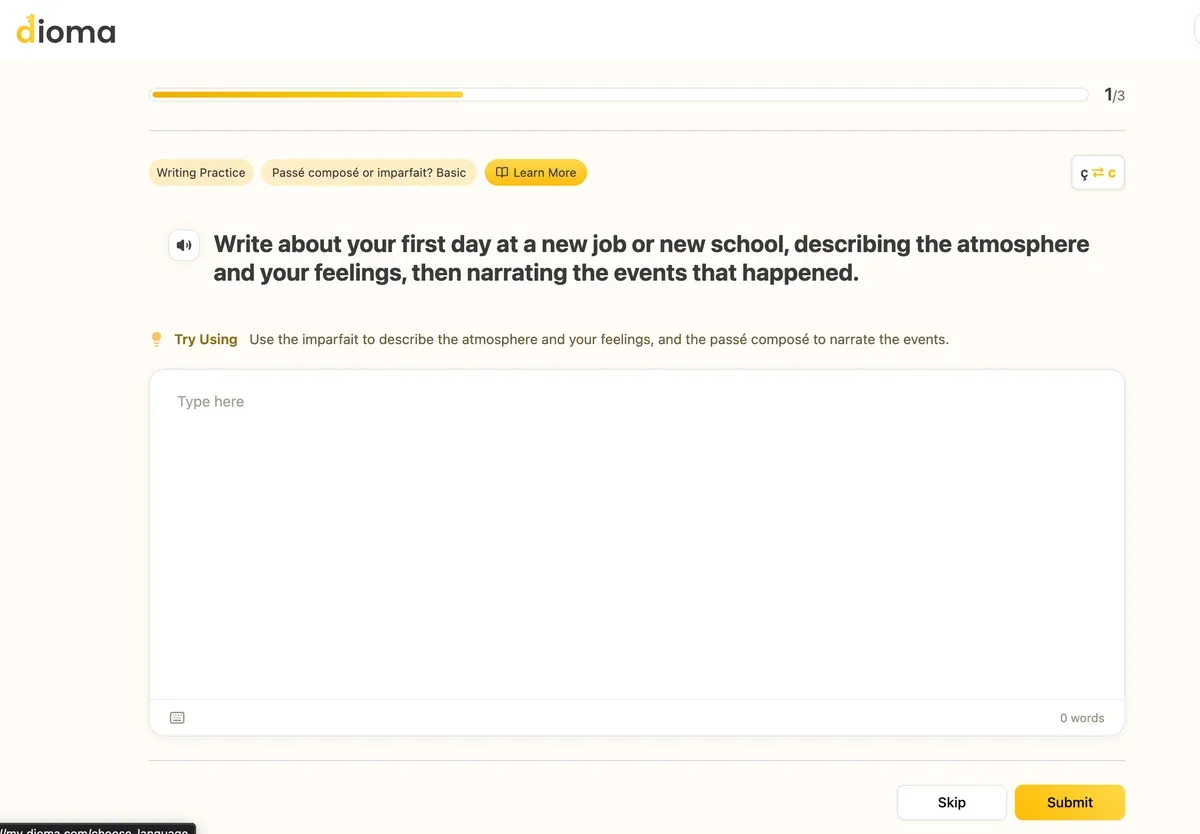
The prompts are better than what you usually get in this category. Instead of "write about booking a hotel," you get a scenario with a note on which structures to reach for.
Mine asked me to describe a first day at a new job, using the imparfait for the atmosphere and the passé composé for the events.
I liked that a lot. Being told which tense to reach for means you can't quietly avoid the one you're bad at.
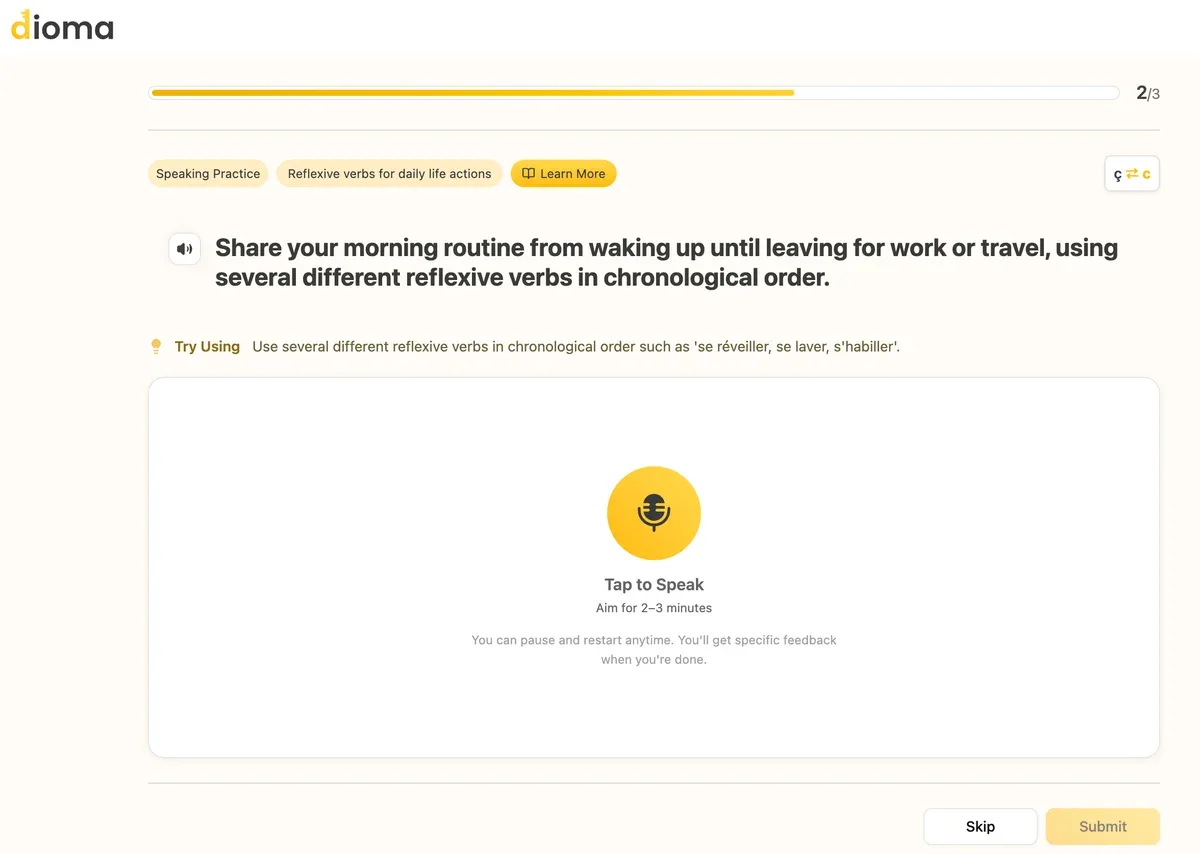
Speaking works the same way. You get the prompt and a target structure, then talk for two or three minutes.
The tasks are meant to feel difficult, and they do.
The corrections are what you're paying for
If the corrections are bad, the rest of it doesn't matter much.
So instead of telling you how they felt, I set out to test them.
The test
I submitted a shopping list task with seven deliberate errors planted in it, helped by my AI-helper, plus six things that look wrong to a learner but are actually correct.
I wanted two numbers out of it: what it catches, and whether it invents anything.
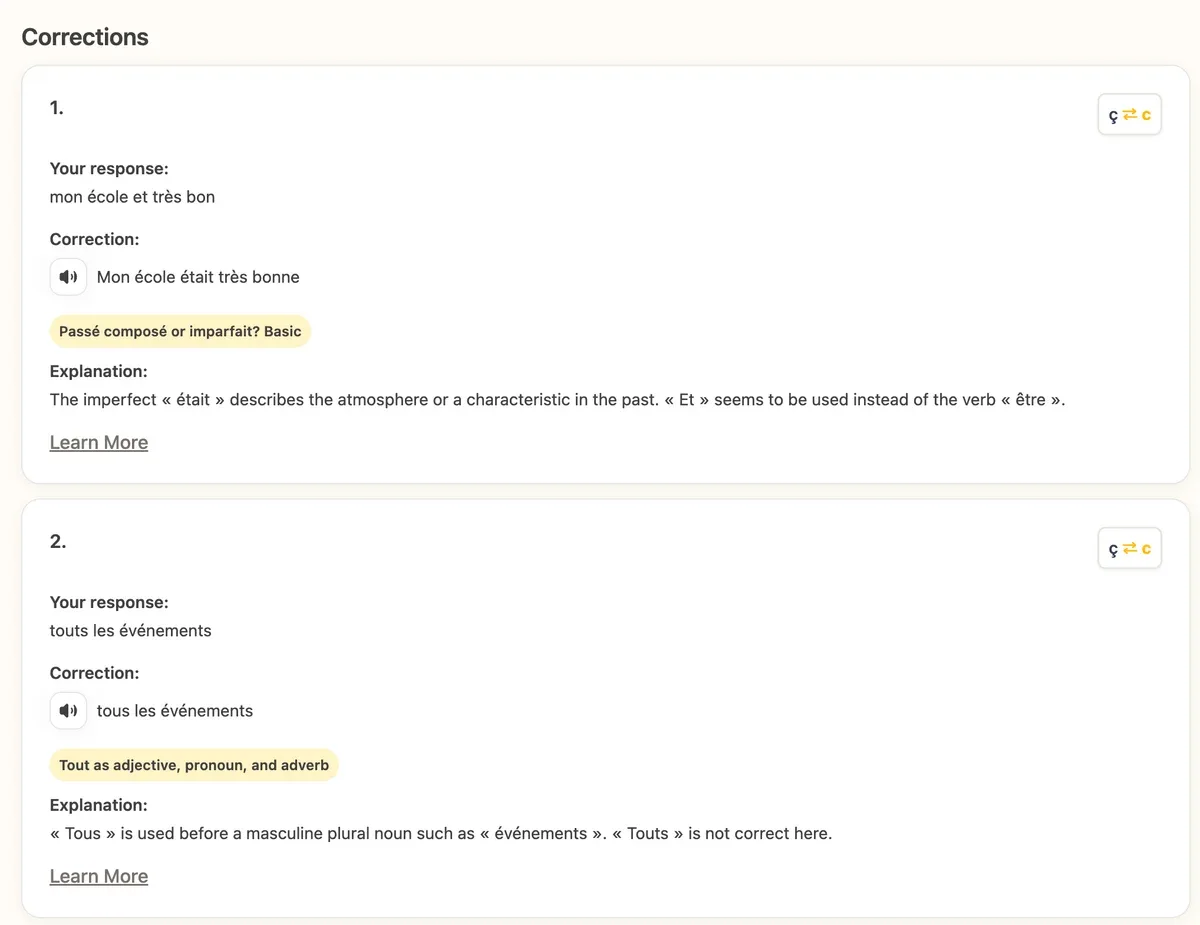
It caught four of the seven. All three quantity expressions, which were the session's own topic, and the subjunctive after il faut que.
The explanations were exact rather than generic. It told me de becomes d' before a vowel, and that je vais is an indicative form where the subjunctive is required.
It also invented nothing at all. All six traps went untouched. It kept the s on quatre-vingts grammes, left un litre et demi in the masculine, and didn't touch une douzaine d'œufs.
Honestly, that second number matters more than the first. A tool that flags correct French as wrong is teaching you errors, and the learner it's built for has no way of knowing.
What it misses, and why
The interesting miss was a sentence that read: Hier, j'organisais une petite fête.
That should be j'ai organisé. One completed event, yesterday, so the passé composé is required.
It sailed straight through. And the topic was passé composé against imparfait, which had been the first exercise of my own session that same morning.
The reason is worth knowing. J'organisais is perfectly good French.
To catch it you have to know that yesterday plus a finished event rules out the imperfect, and that is a judgement about context rather than form.
It read that same sentence closely enough to catch the subjunctive a few words later, so it wasn't skimming. It just doesn't police that kind of error.
So don't treat a clean report as proof your writing was right.
The mistakes that slip through are the ones where you've built a correct sentence that says the wrong thing.
Which might be overkill for most learners anyway. Often, it's not worth stopping over every single little thing.
Precision over recall
A few things point the same way here. It won't score your pronunciation, it drops any correction it can't tie to a topic a person wrote, and it invented nothing across six traps built to bait it.
I think that's the right call. I'd rather it kept quiet than told me something wrong.
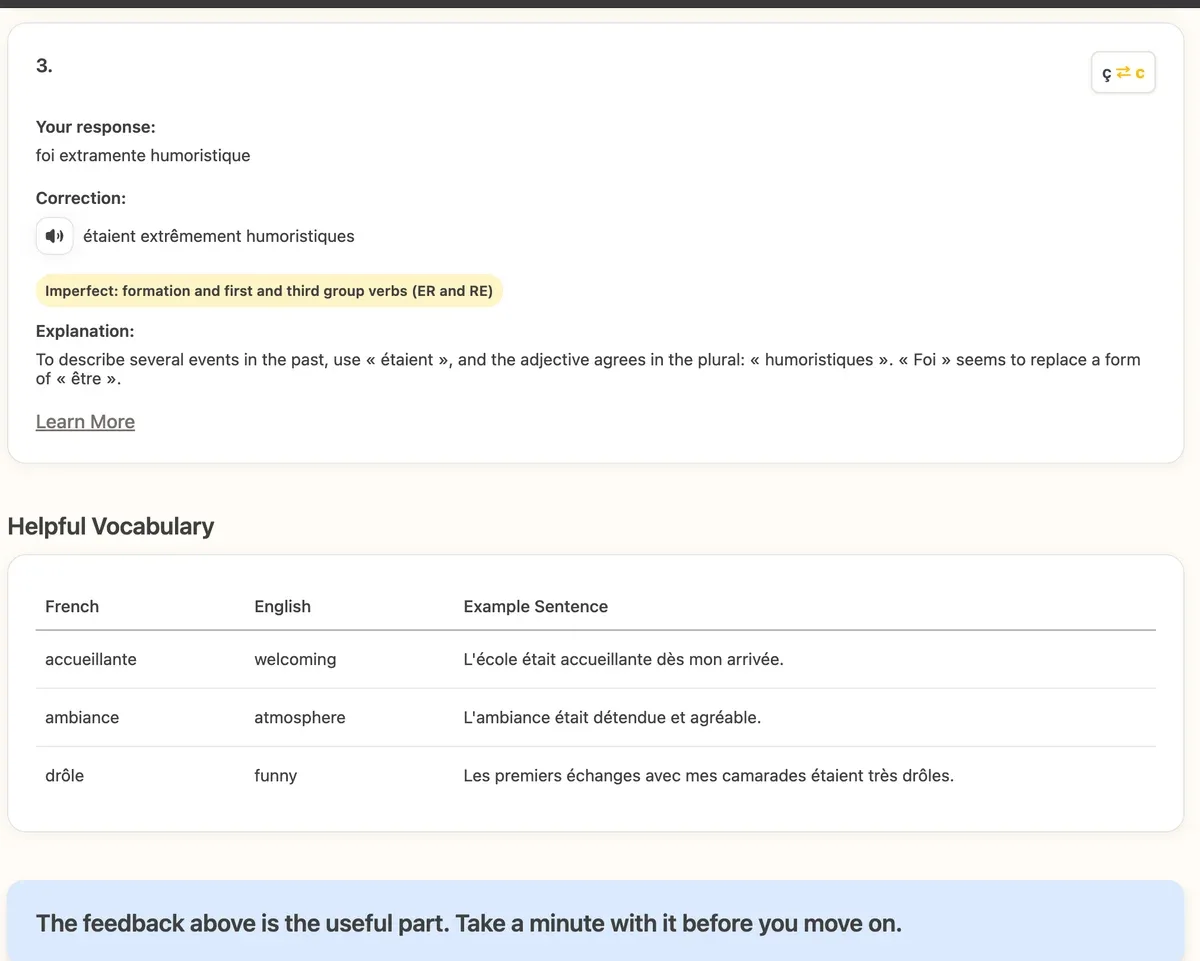
You can see the same instinct underneath the corrections, where the vocabulary it offers comes with example sentences that all use the structure you just fumbled.
Then there's a line at the foot of the page: "The feedback above is the useful part. Take a minute with it before you move on."
You don't see that on many other apps that are built around gamification and dopamine hits to keep you coming back.
(Dioma is distinctly anti-gamification and gimmick-free - a very refreshing take in modern language learning.)
For a learner who can't evaluate the feedback, precision is the right way round. It's the opposite of the story app I reviewed recently that told me my accent was 98 percent perfect.
It learns more about you as you use it
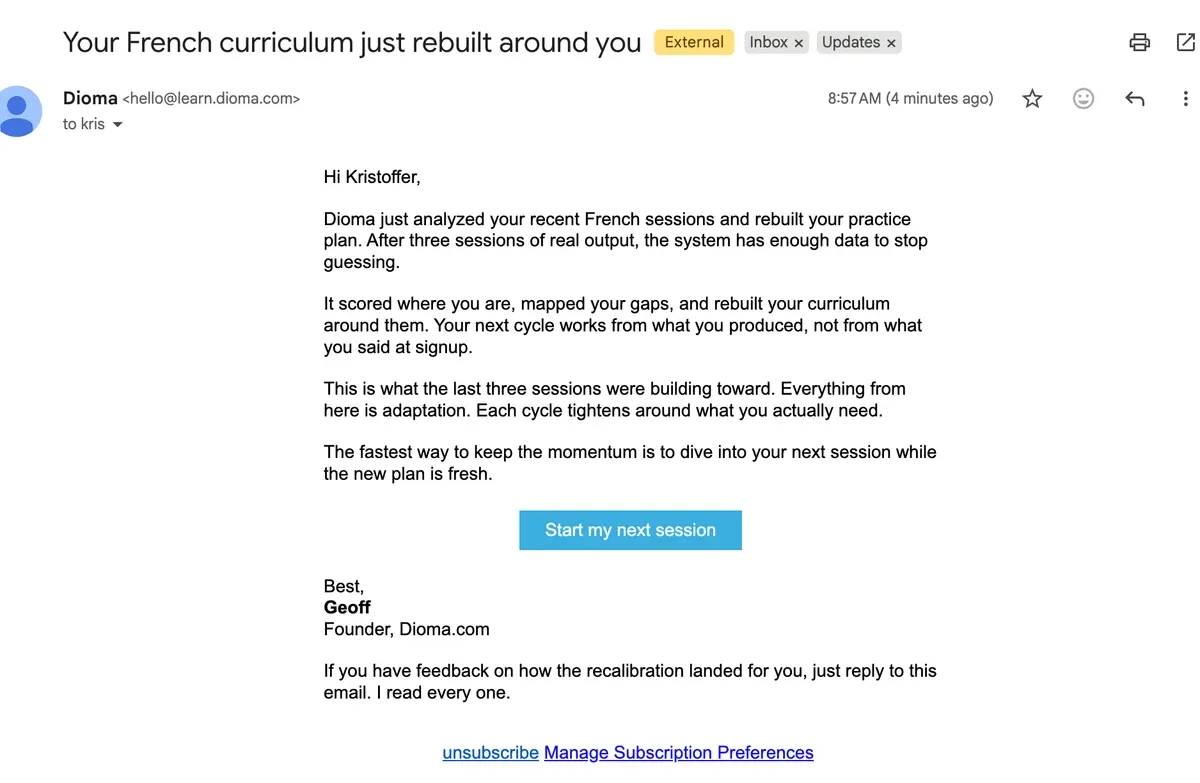
After three sessions the system revised my level, and emailed to say so.
At this time it's got enough data to stop guessing, and the next cycle works from what you produced rather than what you claimed at signup.
That clears up my worry about self placement. What you say about yourself is scaffolding, and evidence replaces it inside a week.
Why the exam shape matters
DELE, run by Instituto Cervantes, is four papers: reading comprehension, listening comprehension, written expression and interaction, and oral expression and interaction. DELF and TEF follow the same four skill shape.
Dioma places you across all four at signup, but the daily work is papers three and four, the two productive ones.
The overlap goes further than you'd expect. The DELE writing paper includes a letter or email written in response to a prompt.
An email was one of my first three tasks.
You could object that this only covers half the exam, and you'd be right. But it's the right half.
Reading and listening you can practise on your own with any book, podcast or past paper, and mark yourself as you go. Writing and speaking you can't, because they need someone to tell you what was wrong.
They're also the papers where people lose marks, so covering just those two makes sense to me.
One caveat, though. Those papers test expression and interaction, and the oral has a real examiner sitting across from you. Dioma's tasks are one way, so don't walk into the oral having only ever spoken into a box.
Like any tool, it won't get you all the way there, and it won't produce a top score on its own.
The AI question
Generative AI does two jobs here. It corrects what you produce, and it drafts your weekly plan from topics that already sit inside your level.
Placement, level moves, progress scoring and session structure all run on fixed rules. Speech goes through a transcription service rather than a generative model.
The curriculum isn't generated either. Educators wrote and reviewed every topic, example and grading note the model works from.
One rule does a lot of the work here. Every correction has to carry the ID of the expert written topic it applies to, and anything pointing at a topic that doesn't exist gets dropped before you see it.
You can watch it happening, too. Each correction I got arrived tagged with a specific topic name rather than a generic label.
They published all of this themselves before I asked, including the part where no human reads your individual correction before you do. You can flag a bad one.
No streaks, no XP
There is no leaderboard and no points.
Progress is measured against CEFR levels, and level moves happen on fixed accuracy thresholds applied the same way for everyone.
I've got mixed feelings about this. Streaks are manipulative and I understand refusing them.
But without one, the work itself has to bring you back, and that's a high bar. It's the part I'd want to check again after a month rather than a week.
Pricing
Three tiers. Annual at $13 a month, quarterly at $16, monthly at $20. There's a 21 day trial with no card, and a 30 day money back guarantee once a plan starts.
One subscription covers all three languages, and any they add later. I opened French on an existing Spanish account without hitting a second paywall.
The annual price sits above the category, though. Across the app subscriptions I've reviewed, the going rate on an annual plan is somewhere around $5 to $10 a month.
The apps priced above that line are Transparent Language, Glossika and FluentU, and none of them are ones I reach for first.
The monthly plan was $29 when I tested it, and Dioma dropped it to $20 in September 2026. That's a much easier number to see first.
Dioma's own answer is that a tutor costs more, and their pricing page runs the less than one tutoring session a month line.
I'm not fully convinced by this comparison.
A tutor is a person who notices what you didn't ask about, and who you can argue with. This is software with nobody in the loop, so it competes with software.
The fair question isn't whether it beats a tutor. It's whether curriculum anchored correction is worth roughly double the going rate for a language app.
Having tested the corrections, I'd say it's worth a premium, and the new $16 quarterly plan is a fairer way in than committing to a year.
Platforms
There's still no app in the App Store or Google Play, but as of October 2026 you don't strictly need one.
You open Dioma's install page in Safari on iPhone or Chrome on Android and add it to your home screen. It then opens full screen from its own icon.
When I tested it, web only was a real limitation. A twenty minute daily habit lives on a phone, and a browser tab isn't an icon.
I haven't tried the installed version yet. Dioma also says speaking tasks now survive a screen lock or a call, which matters most on a phone.
Who this is for
- Intermediate learners whose problem is accuracy rather than nerve. You'll happily talk, but you keep making the same mistakes and nothing corrects them.
- Anyone who won't practise without a plan, and who stalls at a blank conversation window.
- People preparing for DELE, DELF or TEF, where the productive papers are the ones that need a corrector.
- Anyone who wants writing practice, which most speaking tools don't offer at all.
- Hebrew learners between A2 and B2, who don't have many other options at this level.
- People who actively dislike being gamified.
Who this is not for
- Beginners. It starts at B1 in Spanish and French, and you'll find it discouraging below that. Dioma say so themselves, and lower levels are in progress.
- Anyone whose problem is confidence rather than accuracy. You need volume and low stakes, and open conversation practice costs less.
- Learners of anything outside Spanish, French and Hebrew.
- Anyone who insists on a native app from the App Store or Google Play.
- People who want open ended conversation. Every task here is one way, and it doesn't claim otherwise.
- Anyone who needs a streak to show up.
Verdict
I like Dioma. It does the boring, useful job of telling you what you got wrong and why, against a curriculum a person actually wrote.
It's also offering different exercises and tasks compared to what most other language apps offer. Preparing for the hard parts of language exams, and maybe being a bit of a maverick by not focusing on gimmicks or gamification - just the raw language learning.
What won me over was the restraint. No pronunciation scoring, no corrections it can't ground in a real topic, and nothing invented across six traps I set for it.
It won't catch everything, and it doesn't claim to. It catches errors of form and lets errors of judgement through, including inside a topic it had just taught me.
Price is the main thing to weigh up, at $13 a month on the annual plan and $20 monthly.
If you're stuck at intermediate because nothing ever corrects you, it's worth the trial. Twenty one days with no card is long enough to find out, and that's the right way to answer the price question for yourself.
Frequently Asked Questions
Dioma
Best for: Intermediate learners whose problem is accuracy rather than confidence, and anyone preparing for the productive papers of DELE, DELF or TEF
Try Dioma for Free